
Mindfulness: From a Path of Liberation to a Commodity
Introduction to the Manifesto "Awakening: A Manifesto for Radical Mindfulness"

In the coming weeks, I will publish a manifesto in several parts—a text I first wrote nearly five years ago, now revised and expanded. The questions it raises have only grown more urgent:
The times demand a critique of mindfulness—and a mindfulness of critique.
Note: This article serves as the introduction to a manifesto that critiques the commodification of mindfulness under capitalism and explores its potential as a politically conscious, transformative practice.
You’ll find a full overview of all parts here and at the bottom of the page.
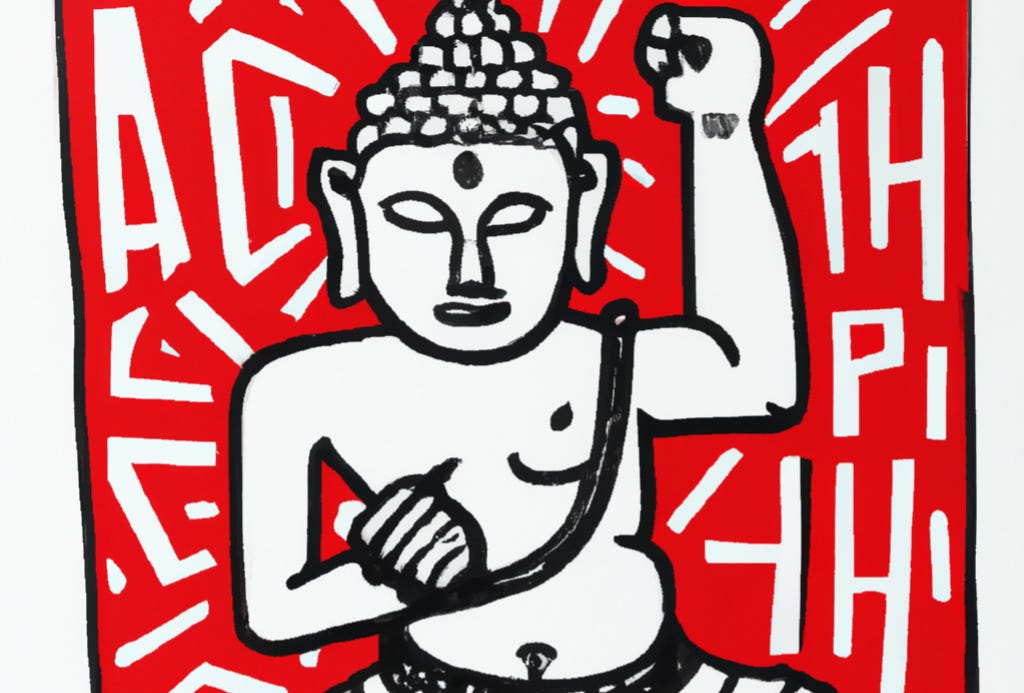
Mindfulness as a Commodity
Mindfulness has become a buzzword, a catchphrase for wellness and productivity. It is sold like a product and consumed like a sedative. In countless corporations, meditation coaches help stressed employees cope with pressure and increase productivity. Countless apps promise better sleep, greater calm, and a stress-free life.
Yet in a world where mindfulness is increasingly commodified, we must ask:
What remains of a practice originally intended for liberation when it is used to stabilize a sick system?
A Depoliticized Space?
Step into the space where meditation and mindfulness are discussed, and it appears almost entirely depoliticized. The world outside—its crises, its conflicts—seems irrelevant. Yet being apolitical means acting politically—without realizing it.
In a world where conflicts are intensifying, where the climate crisis is no longer a distant, abstract specter but increasingly breaking into our daily lives, it is not enough to think of one’s own liberation as a solitary endeavor detached from the realities of the world. This does justice neither to the aim of reducing suffering in the world nor to the Buddhist tradition.
Being apolitical means acting politically—without realizing it.
The Responsibility of Practitioners
Thus, the question of mindfulness in today’s world is directed not only at those who consume it but also at those who take Buddhism and its techniques seriously—those whose mindfulness practice does not stop at ‘feeling-a-little-better’ but instead aims at unlocking the transformative power of mindfulness.
What is personal liberation, what is individual awakening worth, when all around us hell rages
Those who wish to liberate the world from suffering must not halt before a political system that has brought us to the brink of ecological collapse. A system that has never delivered on the promise of democracy or equality and instead perpetuates conflict, war, and ever-growing inequality.
It is a mistake to locate suffering solely in one's own perception—a mistake that plays directly into the hands of the powerful. It ignores that things are interconnected—that my actions—or my inaction—are inseparably linked to the suffering of others. What justifies devoting hours upon hours to personal liberation while others can barely get by? What is personal liberation, what is individual awakening worth, when all around us hell rages—when others, humans and non-humans alike suffer?
This does not mean we should stop meditating—but it does mean we must confront the political dimension of mindfulness. This opens the door to tactical and strategic considerations about how to navigate the dilemma of systemic entanglement and how to harness mindfulness’s immense potential for critical thinking and progressive politics.
It is a mistake to locate suffering solely in one's own perception—a mistake that plays directly into the hands of the powerful.
A Manifesto for Radical Mindfulness
Each article stands on its own, but together they form a manifesto: a plea to think of Buddhism as a radical path of liberation that does not shy away from addressing political realities. A plea to reclaim mindfulness from the grip of capitalism, to rediscover and harness its transformative power.
Why is it dangerous to view mindfulness as apolitical?
What is its political potential for progressive liberation movements?
This manifesto is a call to calm the mind—and change the world. True mindfulness emerges when we ‘kill’ the false one—and with it, the illusion that true liberation is possible without transforming the world.
If something in these words was worth staying with—consider supporting The Undercurrent. Subscribe or support via Ko-fi. It helps me keep writing.

🧭 Fields
Buddhism, Capitalism, Climate Crisis, Critique of Ideology, Critical Theory, Ethics, Ideology, Meditation, Mindfulness, Neoliberalism, Philosophy, Politics, Radical Politics, Social Change, Subversive Practices, Wellness Industry
🗿 Minds
🌊 Movements / Traditions
Activism, Critical Buddhism, Engaged Buddhism, Progressive Movements, Secular Buddhism, Western Buddhism
🧵 Concepts
Capitalist Realism, Critical Thinking, Ecological Crisis, Emancipation, Empowerment, False Consciousness, Individualism, Inequality, Inner Work and Outer Change, Interconnectedness, Liberation, McMindfulness, Radical Mindfulness, Revolutionary Thinking, Ontology of Suffering, Praxis and Theory, Productivity, Soteriology, Suffering, Systemic Entanglement
Overview of the Series
Opening: Mindfulness: From a Path of Liberation to a Commodity
Introduction: The Critical Potential of Buddhism
Mindfulness
Critique of Mindfulness
This post was originally written in German.