

Note: This is the first part of a manifesto that critiques capitalism’s appropriation of Buddhism and mindfulness—while also tracing their transformative power.
New here? The Introduction sets the stage.
You’ll find a full overview of all parts here and at the bottom of the page.
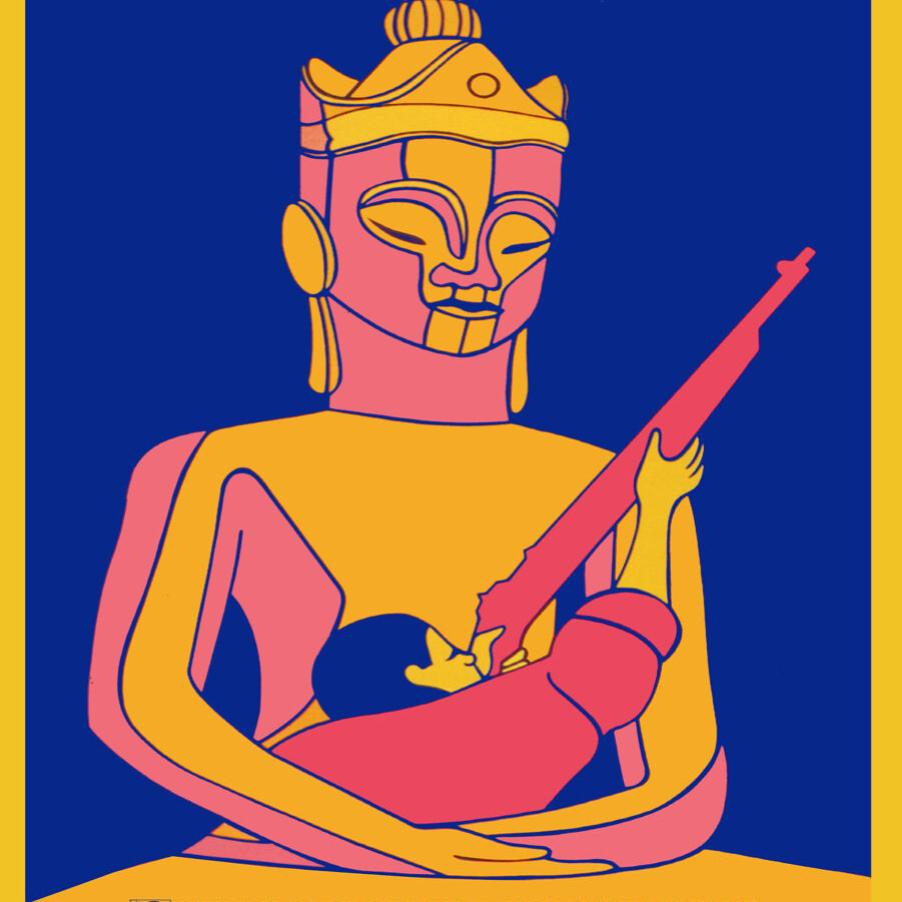
A line of escape, yes—but not a refuge. The creative line of escape vacuums up in its movement all politics, all economy, all bureaucracy, all judiciary: it sucks them like a vampire in order to make them render still unknown sounds that come from the near future.
― Gilles Deleuze, Félix Guattari
Introduction
“IF YOU MEET THE BUDDHA, KILL HIM!”
And he must die—die in his current form: appropriated by the West, repackaged, and cannibalized by a voracious capitalist logic that exploits everything for its own ends. Today, the Buddha sits atop penthouses, huddles in rented rooms, or drifts through suburban homes dazed by incense.
Yet the problem with contemporary Buddhism isn’t that it’s practiced by Silicon Valley executives, cashiers, or middle-class spiritualists. In one respect, modern Buddhism surpasses its historical predecessor: it has become democratized. Its practices are accessible to all.
The problem is that this Buddhism has become immanent to the capitalist system—indeed, it even stabilizes it. A system that knows only growth and progress: growing inequality, unbridled exploitation, and relentless destruction.
At their core, meditation and mindfulness aim to cultivate clarity
—and foster a critical perspective on the world.
The Critical Core of Buddhism
But Buddhism has a critical core: The ultimate goal of Siddhattha Gotama’s teaching—the historical Buddha—is to perceive reality as it is and thereby alleviate suffering. Meditation and mindfulness, central to his practices, are meant to help us achieve clarity. They can enable us not only to critically observe the world but also to adopt a resolute stance toward existing conditions. To see things as they are also means confronting political realities and unequivocally naming them when they cause suffering.
Unveiling this critical, even subversive, core of Buddhism, and thinking of these practices politically, is the aim of this manifesto. Buddhism must become political again. Indeed, Buddhism is only truly Buddhism when it is political.
Politics is part of reality—a part that ostensibly aims to reduce suffering yet often becomes its greatest cause. If Buddhism intends to fulfill its commitment to seeing reality as it is and alleviating suffering, it must itself be political.
Buddhism? Not as religion, but as a way of thinking, a way of being in the world, an ethic! Early Buddhism was not an apolitical doctrine; it emerged during a time of profound societal upheaval. It was a response to the rise of early states and the power structures they introduced. Gotama and his followers consciously reacted to the new political conditions of their time, developing an ethic and practice that radically questioned the roots of suffering in the world. This historical awareness of early Buddhism invites us to rethink Buddhism today—as a teaching capable of transforming both social structures and their ideological foundations.1
Buddhism must become political again.
Indeed, Buddhism is only truly Buddhism when it is political.
Vast and wide, not a thing is holy.2 Buddhism has long become a religion: with dogmas, leader cults, exclusions, superstitions, and more. Yet Gotama himself consistently demanded a critical spirit from his followers—insisting on independent thought. The Buddha must die!
In doing so, he resisted, albeit unsuccessfully, the absolutization of his person and teachings. He is not a savior. Liberation does not come from above, nor does it come for free. It requires effort, courage, and perseverance—and plenty of it.
The Boundaries of Capitalist Thought
This is the Buddhism we mean here—the Buddhism we seek to reclaim, in line with the Buddha’s call to think for ourselves.3 A Buddhism that critiques itself and radically reimagines itself. A Buddhism that dares to follow the call:
»If you meet the Buddha, kill him!«
This statement—a kōan, one of those Buddhist language games that, through paradoxical phrasing, seeks to open a space for thinking and experience beyond language—calls for a radical transcendence, for a shifting of boundaries of thought: Away with cults, away with blind faith, away with the great Other.
And it is precisely this transcendence that is the goal of this manifesto: to overcome multiple boundaries of thought.
There can be no end to suffering, the goal of Buddhism, within capitalism,
for capitalism is built on suffering.
The First Boundary: Capitalism as a Transcendental Limit
Mark Fisher aptly described “capitalist realism”: Capitalism4 as the unsurpassable horizon, the transcendental limit of thought—and thus, our seemingly inescapable reality.5
We live in a world where capitalism is ubiquitous, in a time when the end of the world seems more imaginable than the end of capitalism.6
Modern Buddhism becomes complicit when it confines itself to this boundary and allows itself to be co-opted by capitalism—when it serves merely as a tool for stress relief or productivity enhancement and no longer questions capitalist reality.
Because the problem has a name: capitalism. A better world within capitalism is not possible. An end to suffering, the goal of Buddhism, cannot exist within capitalism, for it is built on suffering.
The Second Boundary: Buddhism as Critical Philosophy
The second boundary to overcome is the one that prevents Buddhism from being conceived as critical philosophy. A philosophy that, if one dares to conceive it, suddenly seems perfectly suited to overcoming capitalist logic.
The failure to recognize this potential stems from the first boundary—capitalism as the unquestioned framework—and also from a leftist blindness, sometimes even arrogance. Too often, mindfulness practices are dismissed as esoteric, system-stabilizing nonsense. A diagnosis that, if it stops there, fails to grasp the critical potential of these practices.
Buddhism’s Subversive Edge
For the very human dynamics Gotama identified as the roots of suffering in the world are the cold engines of capitalism—dynamics that capitalism has planted in place of an ethic, in place of a heart. Capitalism has an almost uncanny ability to transform our desires and fears into its driving force. Its success—within its own metrics—is undeniable.
Yet what may initially appear to be a sublimation of these negative aspects of humanity is, on closer inspection, the opposite. Our desires know no limits; suffering perpetuates itself.
The result: limitless craving, endless suffering. The destruction of our planet or the staggering rates of depression are just two symptoms of capitalism that vividly illustrate the growing suffering in the world.
Buddhism can help us here, for it has a goal: to provide humans with techniques to overcome attachment and craving. Buddhism’s potential is subversive—it targets the very heart of capitalism.
This manifesto aims to restore contingency to its rightful place:
to to show that the world is not bound to be as it is.
The Task of This Manifesto
This manifesto aims to uncover the subversive core of Buddhism. It seeks to provide impulses for thought and carve paths that have been avoided by both the left and Western Buddhism alike.
It is about restoring contingency to its rightful place: demonstrating that the world is not bound to be as it is. It is about reclaiming Buddhism for the left and repoliticizing it—exploring how today’s ubiquitous mindfulness can become a tool for building a better world, rather than a crutch for capitalism.
Blind certainty, a close-mindedness that amounts to an imprisonment so total that the prisoner doesn’t even know he’s locked up.8
― David Foster Wallace
The Undertaking
The Art of Holding Contradictions in Thought
Audi alteram partem. This text will repeatedly run against a wall—a wall of complexity, of pros and cons. Yet it is precisely here that one of the greatest achievements of Buddhist thought lies: the ability to hold contradictions in thought. This does not mean enduring conflicting forces imagined as a harmonious whole—let alone tolerating unjust conditions.
This refers to focused, critical thinking capable of holding different—even contradictory—thoughts in mind while still acting. A way of thinking that does not take the easy way out, that remains self-critical at all times. A way of thinking that sometimes simply asks questions, refrains from hasty conclusions, and instead weighs options mindfully. A way of thinking that recognizes that a strength can simultaneously be a weakness—or that what once seemed like a disadvantage may suddenly reveal itself as an advantage.
Yet sometimes, when the line becomes so thin that the question of where one stands—inside or outside, ethical or not—is almost impossible to answer, such thinking must make decisions and provide answers—it must act. At times, this means resting self-critically within oneself; at others, acting with ethical resolve. What is required is both radicality and mindfulness: a radical mindfulness and a mindful radicality.
It is in the space of interplay between inner reflection and external reality
that the potential of mindfulness and radicality unfolds
—a space where transformative change toward a better world becomes possible.
Radical Mindfulness and Mindful Radicality
Radical mindfulness means questioning one’s patterns of perception, preconceptions, actions, and their consequences under the conditions of the present system—to their deepest roots. It is mindfulness beyond the comfort zone. Mindfulness as a critical practice.
Mindful radicality, on the other hand, means proceeding with care—without falling into blind activism or dogmatic convictions. Instead, it remains open to the feedback of reality and the criticism of others. For radical thinking without self-reflection leads directly to the kind of self-satisfied, tribalist behavior and politicking that has brought us so dangerously close to the abyss.
It is precisely in this space of interplay between inner reflection and external reality that the potential of mindfulness and radicality unfolds—a space where transformative change toward a better world becomes possible.
Radical thinking refuses to settle for what is; it sees itself as an infinite task
and does not shy away from effort.
Radical Thinking and the Deconstruction of the Self
Radical thinking questions itself, reaching down to its own roots (radix in Latin). It continually interrogates its own conditions, willing to transcend itself —to break through its own framework. Refusing to settle for what is, it sees itself as an infinite task and does not shy away from effort.
Mindfulness and meditation cultivate such a way of thinking: Nothing is safe from them. The world as it appears to us, the world as it is, is radically called into question. The conditions of one’s own being are interrogated to the point of dissolving the self.
Dismantling the capitalist self requires work: on the system and on the self.
The Left in Stasis
This radicality of Buddhism must be embraced by a Left that finds itself frozen in shock paralysis—immobilized in the face of a resurgent Right. Trapped in a conservatively self-satisfied stance and a hyper-moralizing posture, it has lost touch with radical, critical thought and courageous action.
Even if we do not follow Buddhism to the point of dissolving the self, it can still help us dismantle the capitalist self—and this requires work: on the system and on the self.
If something in these words was worth staying with—consider supporting The Undercurrent. Subscribe or support via Ko-fi. It helps me keep writing.

🧭 Fields
Buddhism, Buddhist Ethics, Capitalism, Climate Crisis, Critical Theory, Critique of Ideology, Early Buddhism, Ecological Crisis, Ethics, Mental Health, Mindfulness, Meditation, Philosophy, Perception, Politics, Radical Politics, Social Change, Subversive Practices, Wellness Industry
🗿 Minds
Buddha, David Foster Wallace, Félix Guattari, Gilles Deleuze, Mark Fisher
🌊 Movements / Traditions
Activism, Buddhism as Counterculture, Contemporary Buddhism, Critical Buddhism, Engaged Buddhism, Neoliberalism, Progressive Movements
🧵 Concepts
Capitalist Realism, Contingency, Critical Thinking, Deconstruction, Emancipation, Empowerment, Epistemic Practic, Epistemic PracticFalse Consciousness, Governmentality, Hypermorality, Inner Work and Outer Change, Inequality, Kōan, Liberation, McMindfulness, Ontology of Suffering, Psychotechniques, Radical Mindfulness, Radical Thinking, Reflexion, Resistance, Revolutionary Thinking, Structural Violence, Subjectivity, Soteriology, Suffering, Systemic Entanglement, Transcendence, Tribalism
Overview of the Series
Opening: Mindfulness: From a Path of Liberation to a Commodity
Introduction: The Critical Potential of Buddhism
Mindfulness
Critique of Mindfulness
This post was originally written in German.
This connection will be explored in greater detail in a later publication.
Saying of the Zen master Kōan Joshu (Zhaozhou).
The term "Buddhism" is used here in the sense of an "affirmative deconstruction" (Judith Butler). With the awareness that there is no such thing as Buddhism per se—"Buddhism" is an open, never-completed project. Precisely because it is changeable, it can be deformed, but it can also be shaped. The goal is to give it a positive form.
Nor is there such a thing as ‘the’ capitalism. What exists is only a crossed-out, inconsistent capitalism, which does not act as a unified entity but is nevertheless necessarily powerful and violent in its effects. See footnote 2.
Cf. Mark Fisher, Capitalist Realism: Is There No Alternative? (Hampshire: Zero Books, 2008).
An argument prominently advanced by Slavoj Žižek and Fredric Jameson in numerous texts. See, for instance, Slavoj Žižek, "Holding the Position," in Contingency, Hegemony, Universality, 400, and Fredric Jameson, "Future City," New Left Review May-June, no. 21 (2003), 76.