
Barthes, Bashō and the Reality Effect of Language
The Lack of Language as the Abundance of Reality

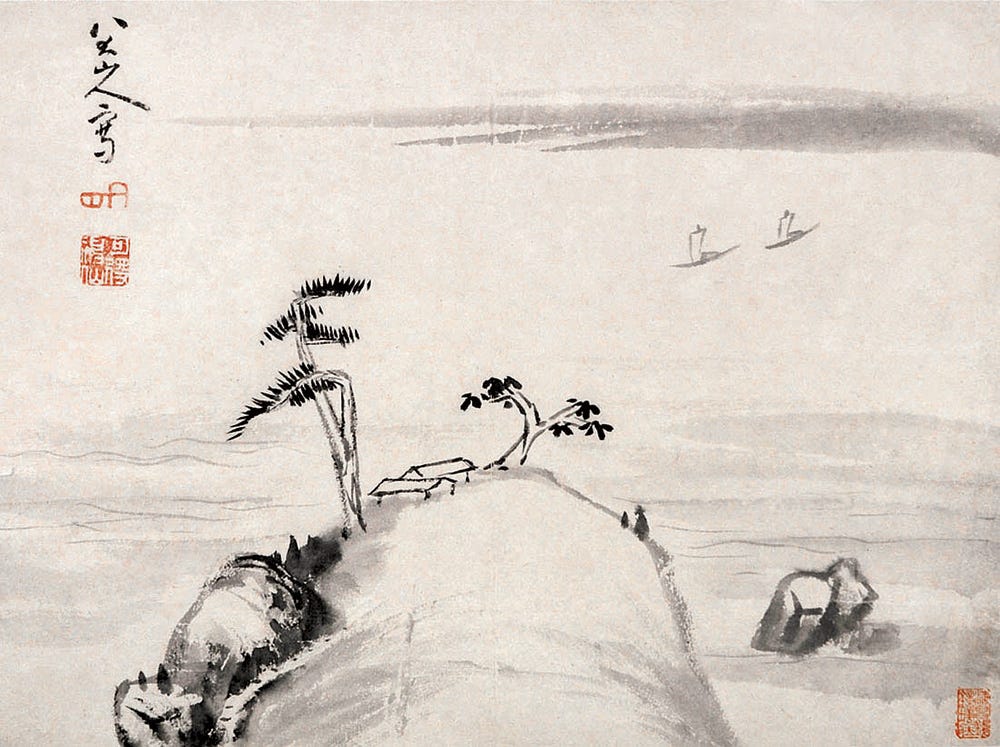
Spring breeze
The boatman
Chews on his little pipe
― Bashō
Roland Barthes quotes this haiku by Matsuo Bashō during a lecture in which he traces the noema—the essence—of the text by way of photography.1 In doing so, he encounters a fundamental question: How can language, much like photography, produce such an immediate reality effect? He finds an initial answer in the noema of photography, which he transposes onto the text: in the that-has-been—the feeling, no, the certainty: it must have been so. Language is capable of what also characterizes photography: making a scene become real.
That photography conveys truthfulness—makes an image appear real—is immediately evident. It is an imprint, an index, a physical trace of a past reality. It promises us: What you see here once existed. When we look at an old childhood photograph of ourselves, it can pierces us like an arrow: This moment once happened. That is us as a child in our parents’ arms—gone, but real. The puncture of reality strikes us with a feeling of ontological certainty. Photography thus serves as a mediator of an appearance of being.
But how does language achieve such a reality effect? How does Bashō manage, with just a handful of words, to evoke a scene—a picture of reality that calls to us as real—a scene whose urgency is only amplified by its sparseness?
Despite the absolute contingency of the scene, Bashō describes: “a sort of transcendence arises—that is to say that all of spring, all the nostalgia for the moment as if it stood out, which will never return, is contained within this 'that-has-been'“.2 It is the “sensation that language vanishes in favor of a certainty of reality.”3
Language withdraws, hides itself, and disappears, so that only what is said remains, naked.4
It is not the attempt to describe reality completely that makes it visible, but quite the opposite: only the individuation of a moment, the description of a tiny detail, renders language transparent. In a single stroke, reality emerges in all its fullness.
According to Roberto Calasso, Franz Kafka too understood this.
Kafka sensed that by then only the minimum number of elements of the surrounding world ought to be named. He plunged the sharpest Ockham’s razor into the substance of the novel. To name the bare minimum, and in its pure literality. And why so? Because the world was turning back into a primeval forest, too fraught with strange noises and apparitions. Everything had too much power. Thus it became necessary to limit oneself to what lay closest at hand, to circumscribe the zone of the nameable. Then all that power, otherwise diffuse, would be channeled there, and whatever was named — an inn, a file, an office, a room — would fill with unprecedented energy.5
But how does pure literality generate such a sense of proximity to reality? Why is it precisely this pruning of language to a small, contingent detail that produces the effect of the real—or rather: effect of reality?6
Perhaps the answer lies in the imbalance between signifier and signified that Claude Lévi-Strauss pointed out:
a fundamental situation perseveres which arises out of the human condition: namely, that man has from the start had at his disposition a signifier-totality which he is at a loss to know how to allocate to a signified, given as such, but no less unknown for being given.7
Words always say less than theoretically could be said. No matter how many words we use, we never fully reach reality. This imbalance—a finite field of signifiers facing an infinitely complex world of signifieds—can be described as a relation of potentiality: the potential of language arises from the epistemological asymmetry between the infinity of meanings and the finitude of available signs. Only because language always says less than it could, does it function as an infinite field of possible utterances.
It is therefore precisely this failure—the not-enough of language—that allows it to transcend itself. Only the impossibility of naming everything opens language to reality.
Sniffed
by the kitten
a snail
― Saimaro
The reality effect of language thus reveals itself as that moment when the potentiality of language becomes palpable—when the lack of language short-circuits with the abundance of reality. Not because it says everything, but because it says less than it could. Precisely where language names the least—where its potential for further naming is greatest—this potential shines through the few words. Language, in its potentiality, points beyond itself: toward reality.
No other sound
Than the downpour
On a summer evening
― Issa
If something in these words was worth staying with—consider supporting The Undercurrent. Subscribe or support via Ko-fi. It helps me keep writing.

⧉ Fields
Philosophy, Language, Philosophy of Language, Writing, Haiku, Literature, Literary Theory, Aesthetics, Epistemology, Photography, Perception, Poetics, Photo Theory, Buddhist Philosophy
⋉ Minds
Roland Barthes, Matsuo Bashō, Franz Kafka, Roberto Calasso, Claude Lévi-Strauss
⧊ Concepts
Reality Effect, That-has-been, Noema, Contingency, Transcendence, Potentiality, Signifier and Signified, Lack, Emptiness, Nomination
This post was originally written in German.
The original title of the lecture was Effet de réel ou plutôt de réalité (Lacan). It was part of the lecture series La Préparation du roman, later published in English as The Preparation of the Novel: Lecture Courses and Seminars at the Collège de France (1978–1979 and 1979–1980).
As I did not have access to Kate Briggs’s official English translation, the translations provided here are based on the original French edition and the German translation. The original French passages are quoted in the footnotes.
Roland Barthes, La Préparation du roman: “la sensation que le langage s’évanouit au profit d’une certitude de réalité”.
Ça a été in French. This is the noema of photography for Barthes: the ontological promise that what is shown has unquestionably existed — a punctuating certainty of having-been-there.
Barthes, La Préparation du roman: “le langage se retournait, s’enfouissait et disparaissait en tant que langage, laissant à nu ce qu’il dit”.
The title—Effet de réel ou plutôt de réalité—draws on Jacques Lacan's distinction between the Real and Reality. For Lacan, 'Reality' (la réalité) is what is seen (and can thus be a lure), whereas the 'Real' (le réel) is a structure that can be demonstrated but not seen. Barthes notes that since the effect he describes pertains to the visible, effect of reality would be the more precise term. He ultimately retains the in French more common, or 'banal', expression: effet de réel.
Quoted in Slavoj Žižek, Less Than Nothing, 584.